“`html
Compression and Grip Socks for Soccer Players:
Why Circulation and Foot Stability Matter
Soccer places repeated demands on the calves, veins, feet, and footwear.
Understanding how circulation, graduated compression, and foot-to-cleat
stability work together can help athletes make better equipment choices.
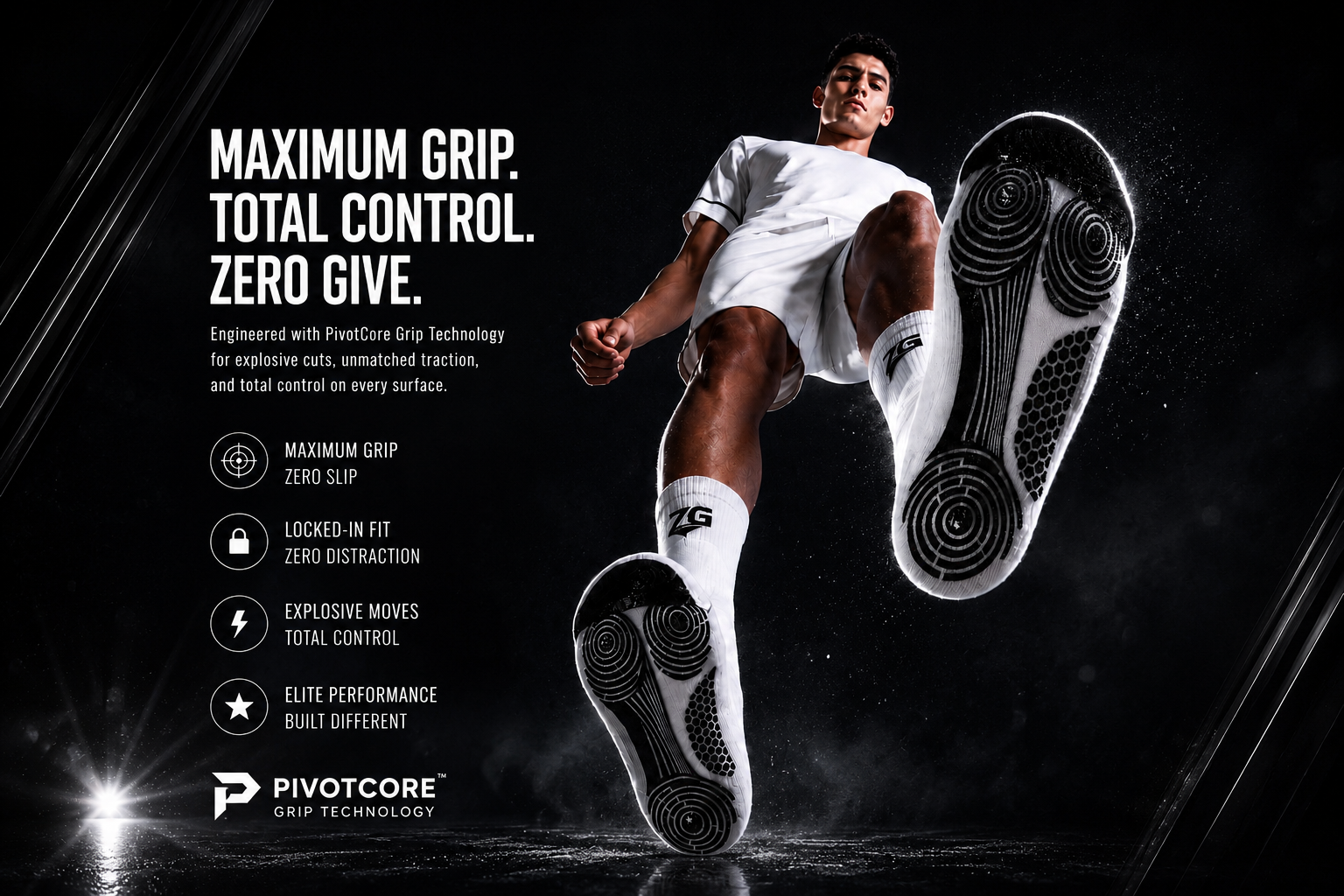
graduated compression and anatomical soccer-specific construction.
During a single soccer match, players repeatedly sprint, decelerate, cut,
jump, strike the ball, and change direction. At the same time, the calf
muscles are continuously helping move blood from the lower extremities
back toward the heart.
For soccer players, performance therefore depends on more than strong
muscles and cardiovascular conditioning. Two often-overlooked factors are
lower-leg circulation and the
connection between the foot and the soccer cleat.
This is where a properly designed compression grip sock can serve two
different purposes: graduated compression can support the lower leg,
while grip technology can help create a more stable interface between
the foot and footwear.
ZERO GIVE™ Soccer Grip Socks
,
which combine graduated compression with soccer-specific grip and anatomical
construction through
PivotCore™ Technology
.
Why Circulation Matters for Soccer Players
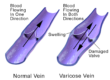
The veins of the legs must move blood upward against gravity. One of the
body’s most important mechanisms for accomplishing this is the
calf muscle pump.
When the calf muscles contract during walking or running, they compress
veins within the lower leg and help propel blood upward toward the heart.
Healthy venous circulation also depends on functioning venous valves,
which help limit backward flow toward the feet.
Soccer activates this system constantly. Players also experience periods
of standing, high-intensity effort, travel, training, and recovery, all of
which place different demands on the lower extremities.
Graduated compression is designed to provide greater external pressure
toward the lower portion of the leg and progressively less pressure farther
upward. In appropriate individuals, this can help support venous return
and reduce excessive pooling of blood and fluid in the lower extremities.
Compression should not be viewed as a replacement for conditioning,
hydration, movement, recovery, or treatment of an underlying vascular problem.
Why Soccer Places Such High Demands on the Calves
Few sports combine repetitive calf activation with the amount of
multidirectional movement required in soccer. The gastrocnemius and soleus
muscles are repeatedly activated during:
Acceleration
Explosive first steps require rapid force production through the foot
and ankle.
Deceleration
Stopping quickly places large demands on lower-leg control and stability.
Cutting
Directional changes require a stable plant foot and efficient transfer
of force.
Jumping & Striking
The calf, ankle, and foot contribute to propulsion, balance, and power
generation.
From a circulatory standpoint, these contractions help activate the calf
muscle pump. From a performance standpoint, however, the athlete also needs
the foot to remain stable inside the cleat.
The Foot-to-Cleat Connection
A soccer cleat can have excellent traction against the field, but that does
not automatically mean the foot is completely stable inside the shoe.
If excessive movement occurs between the foot, sock, and cleat, the player
may experience unwanted sliding or rotational movement inside the shoe.
This can become especially relevant while planting before a shot,
accelerating from a stationary position, or performing a rapid change
of direction.
A performance grip sock is designed to increase stability at this internal
interface. This concept is central to the design of
ZERO GIVE™ Grip Socks
.
Why Grip Socks Have Become Popular in Soccer
Traditional soccer socks primarily provide coverage and comfort.
Modern
soccer grip socks
add traction surfaces intended to reduce unwanted movement between the
sock and footwear.
- Greater foot stability inside the cleat
- Reduced unwanted heel movement
- More secure planting during changes of direction
- More consistent foot-to-footwear contact
- Less internal sliding during acceleration and deceleration
The objective is not to make the foot completely immobile. The goal is to
create a stable and responsive connection between the athlete and
the cleat.
Combining Compression With Grip
Compression and grip perform different functions.
Compression
Supports the lower leg and foot through external graduated pressure.
Grip
Addresses the mechanical interface between the foot, sock, and soccer cleat.
ZERO GIVE™ Grip Socks
combine 12–20 mmHg graduated compression with the company’s
PivotCore™ performance architecture
.
What Is PivotCore™ Technology?
PivotCore™ Technology
is the performance architecture used in ZERO GIVE™ Grip Socks.
It combines strategic traction with anatomical support intended to improve
the connection between the foot, sock, and footwear.
- Strategic external grip placement
- Right- and left-specific anatomical construction
- Targeted performance zones
- Foot and ankle support
- Lycra®-based compression
- Moisture-management fibers
- Lightweight construction
create a more secure interface through which an athlete transfers force
from the leg, through the foot and cleat, and ultimately into the ground.
Compression Without Excessive Bulk
For soccer players, compression cannot come at the expense of cleat fit.
Modern soccer boots are often constructed with thin synthetic uppers and
tight internal dimensions. Adding a thick sock can change how the boot fits
and may reduce the close-to-ball feel many players prefer.
ZERO GIVE™ uses a technical fiber blend rather than cotton:
Nylon
Lycra®
Coolmax®
Players can review the construction and specifications of the
ZERO GIVE™ compression grip sock
.
The absence of cotton is relevant because cotton tends to absorb and retain
moisture. Technical moisture-management fibers are generally better suited
for athletes training and competing at high intensity.
Why Moisture Management Matters
Sweat changes the environment inside a soccer cleat. As the foot becomes
wet, friction characteristics can change and the athlete may experience
additional movement between the skin, sock, and shoe.
Coolmax® fibers are designed to help move moisture away from the foot,
while Lycra® contributes elasticity, compression, and fit.
Can Compression Improve Soccer Performance?
Compression garments should not be represented as devices that automatically
make an athlete faster or prevent injury.
Their more established role is providing external compression and potentially
supporting venous return, swelling management, and subjective leg comfort
in appropriate individuals.
Athletic performance depends on many factors, including strength,
conditioning, biomechanics, footwear, hydration, recovery, fatigue,
and technique.
Similarly, grip socks cannot replace strength, technique, or properly
fitted cleats. They are equipment designed to improve the interface between
the athlete and the shoe.
Who May Benefit From Compression Grip Socks?
- Competitive youth soccer players
- Academy players
- Collegiate players
- Professional players
- Athletes training several times per week
- Players competing in tournaments with multiple matches
- Athletes who frequently travel to competitions
Players who spend long periods sitting during flights or road trips should
also understand the importance of regular movement, hydration, and
lower-extremity circulation.
Compression may be useful in certain circumstances, although athletes with
known arterial disease, significant vascular disease, unexplained leg swelling,
or other medical conditions should discuss compression with a physician
before use.
The Importance of Proper Fit
Compression only functions appropriately when the garment fits correctly.
A sock that is too loose may provide inadequate compression, while a sock
that is excessively tight or rolls into a narrow band can become uncomfortable
and may be inappropriate.
Similarly, a grip sock should not bunch inside the cleat. Anatomical right-
and left-foot construction can help the sock follow the contours of the foot
more naturally.
ZERO GIVE™ incorporates anatomical construction into its
PivotCore™ system
.
The Bigger Picture: Performance Begins at the Ground
Soccer players routinely spend hundreds of dollars evaluating different
cleats. They consider stud configuration, boot weight, upper material,
soleplate stiffness, heel lockdown, and touch on the ball.
But the sock sitting between the foot and cleat is often treated as an afterthought.
Every sprint, cut, jump, pass, and shot ultimately depends on the interaction
between the athlete and the ground. That connection begins at the foot.
A properly designed soccer sock should therefore do more than simply cover
the foot. Ideally, it should manage moisture, maintain fit, provide appropriate
compression, and help stabilize the interface between the foot and boot.
That is the concept behind
ZERO GIVE™ Grip Socks with PivotCore™ Technology
.
Compression, Circulation and Soccer: The Bottom Line
For soccer players, lower-extremity performance involves multiple systems
working together. The muscles generate force, the calf muscle pump supports
venous return, the foot transfers force, and the cleat transfers that force
into the ground.
A well-designed compression grip sock sits directly in the middle of this
system. Graduated compression can help support lower-extremity circulation,
while soccer-specific grip technology can help reduce unnecessary movement
between the foot and cleat.
For players interested in combining those concepts, ZERO GIVE™ Soccer Grip
Socks incorporate
12–20 mmHg graduated compression, anatomical construction,
moisture-management fibers, targeted grip architecture, and
PivotCore™ Technology.
This article is provided for general educational purposes and is not intended
to diagnose or treat any medical condition. Compression garments may not be
appropriate for every individual. Athletes experiencing persistent leg swelling,
pain, skin changes, numbness, abnormal discoloration, suspected arterial disease,
or other vascular symptoms should be evaluated by a qualified medical professional.
“`